

If you’re currently hunting for a deal on high-speed memory, you might want to look closer at what’s actually under the hood. A troubling new trend has emerged in the hardware market where scammers are selling fake DDR5 memory modules that are not just slow—they’re physically hollow.
This issue has gained traction following reports from Overclock3D and Wccftech, highlighting a sophisticated scam where “plastic” hardware is being passed off as premium tech.
The “Plastic” Discovery
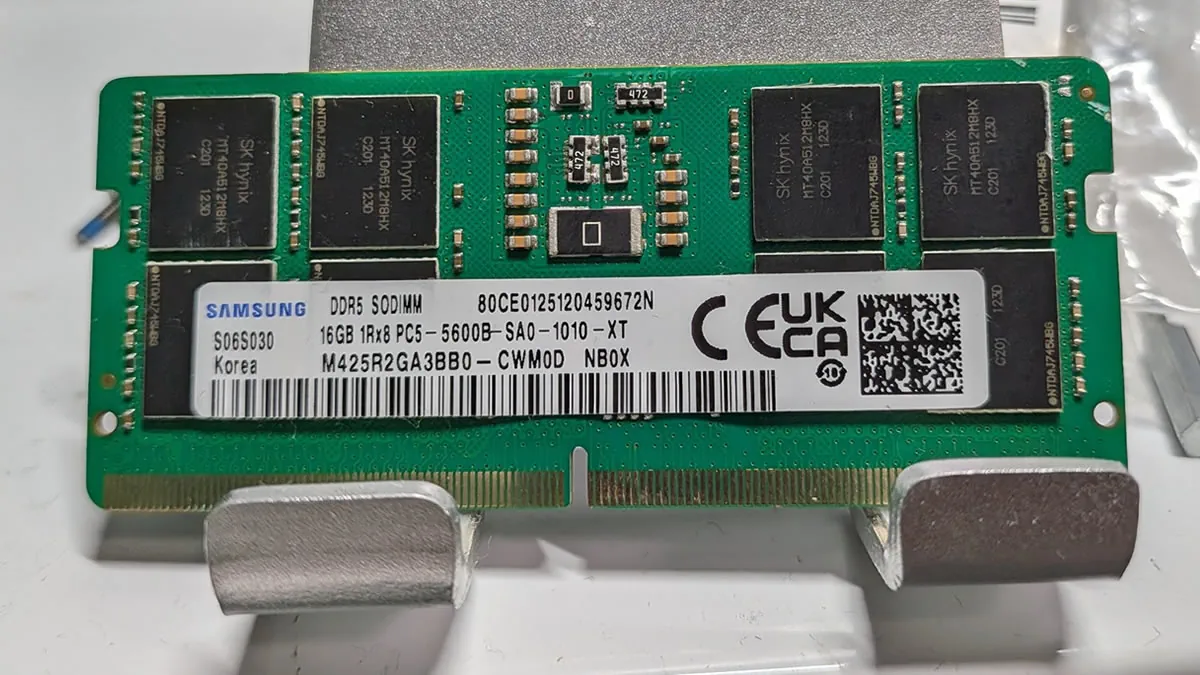
The alarm was first sounded by tech enthusiast and reviewer Taki Udon on X (formerly Twitter), who shared a deep dive into a suspicious 16GB DDR5 SO-DIMM module purchased in Japan. At first glance, the module looks convincing, complete with a professional-looking “Samsung” label.
However, upon closer inspection, several red flags emerged:
Contradictory Branding: While the external sticker claimed the module was made by Samsung, the actual chips on the board were lazily stamped with “SK Hynix” logos. Since Samsung manufactures its own DRAM, they would never use a competitor’s chips.
The “Hollow” Truth: In a follow-up, the chips were actually cut open, revealing that there was no silicon inside. These aren’t just defective chips; they are literal blocks of plastic designed to look like memory.
Physical Anomalies: The “gold fingers” on the bottom of the RAM (the contact points) appeared poorly finished, and the overall PCB design had rounded edges that don’t match official manufacturing standards.
Why Is This Happening?
According to reports, the resurgence of these scams is being fueled by a global memory supply shortage and skyrocketing prices for DDR5. Scammers are preying on the “deal-hunting” culture of the PC community, listing these fake modules for roughly 12,845 Yen (about $80 USD)—a price low enough to be attractive but high enough to seem somewhat “legitimate” for a 16GB stick.
How to Spot a Fake
As these fakes become more common, here is what you should look for to avoid getting burned:
Check the Branding Logic: As seen in Taki Udon’s report, if the label says Samsung but the chips say SK Hynix (or vice versa), it is 100% a fake.
Inspect the PCB Quality: Real DDR5 modules have high-precision manufacturing. If the edges of the circuit board look rough or the gold contacts look uneven or dull, be wary.
The “Too Good to be True” Price: If a high-end kit is significantly cheaper than the market average during a known shortage, it’s a major red flag.
No-Return Policies: Many of these fakes are sold on third-party marketplaces (like certain AliExpress or eBay listings) where the seller explicitly states “No Returns.”
While DDR5 remains a must-have for modern Intel and AMD builds, the current advice from the tech community is clear: stick to authorized retailers and big-name brands. Saving $20 on a “no-name” or “gray market” listing could result in you buying a very expensive piece of plastic.
Sources:





























 Omada
Omada